Resume Keyword Scanner: Find Missing Keywords From Any Job Description
Introduction: Why 75%+ of Qualified Applicants Suffer from Hidden Keyword Gaps
You spent hours polishing your work experience, formatting your bullet points, and crafting what you believe is an outstanding resume. You hit "Submit" on a job posting in the US or UK that matches your background perfectly—and then... silence. Days turn into weeks, and the only response you receive is an automated notification stating that the hiring team has decided to "move forward with other candidates whose qualifications more closely align with the role."
What went wrong? In over 85% of cases in top hiring markets across North America and Great Britain, your resume was not rejected by a hiring manager who read your credentials. Instead, it was filtered out by an Applicant Tracking System (ATS) before a human ever set eyes on it.
Corporate hiring teams using enterprise ATS platforms like Workday, Greenhouse, Lever, Taleo, or SAP SuccessFactors process hundreds of applications per job posting. To filter candidates efficiently, these automated gatekeepers perform an algorithm-driven comparison between your document and the employer's job posting. If your resume is missing the exact technical skills, software tools, industry terminologies, or core action verbs specified in the posting, your application is scored below the passing threshold.
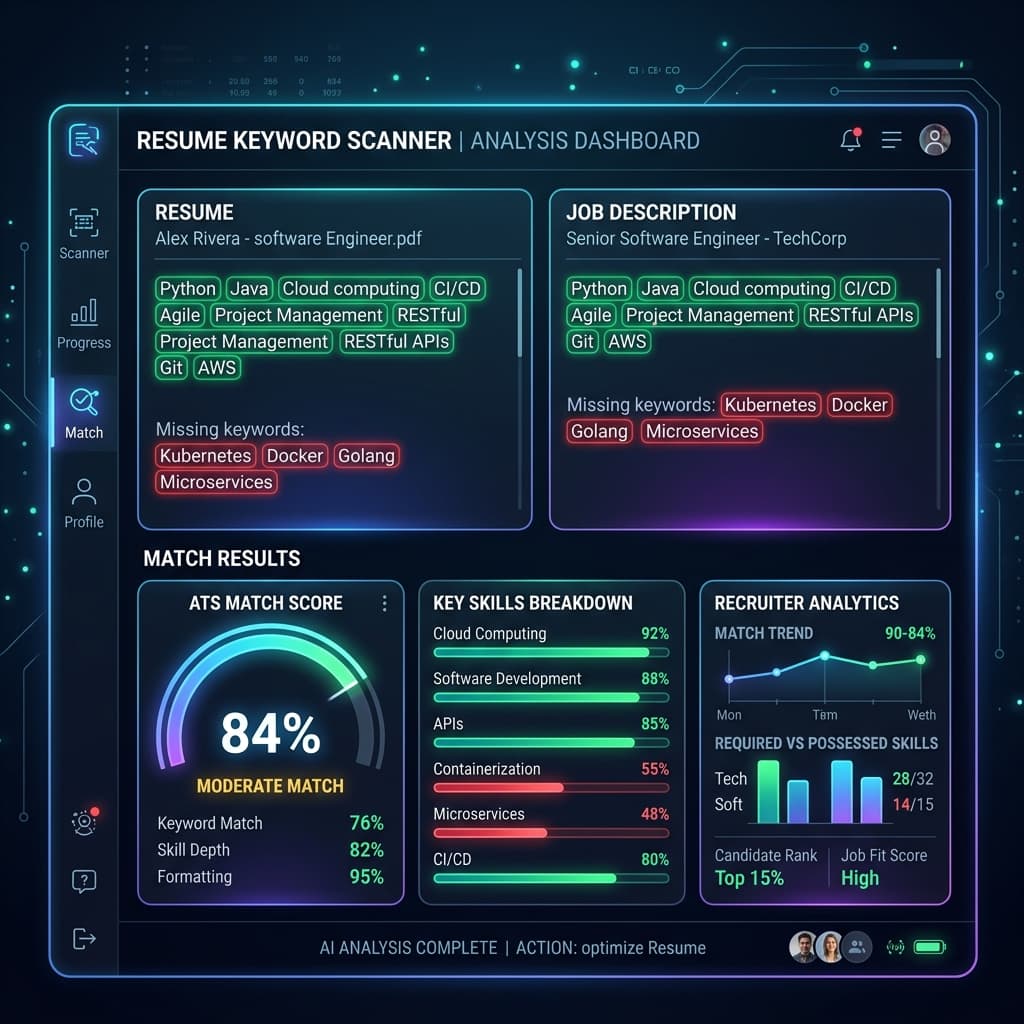
This is why using a dedicated Resume Keyword Scanner: Find Missing Keywords From Any Job Description is no longer optional—it is an essential, high-leverage strategy for modern job seekers. By running a real-time keyword gap analysis prior to submitting your application, you can pinpoint the exact terms you missed and bridge the gap between your true experience and what the ATS algorithm demands.
How a Resume Keyword Scanner Works Under the Hood
To understand why automated scanning is so effective, you must first look at how recruitment parsing engines analyze digital text. Modern ATS screeners do not "read" resumes the way humans do. Instead, they ingest the raw text of your document and split it into tokens, entity tags, and skill categories using Natural Language Processing (NLP).
When an enterprise recruiter creates a job opening, the software automatically parses the job description and generates an index of required qualifications. It extracts four major categories of target terms:
- Hard Technical Skills: Concrete software tools, programming languages, equipment, protocols, or frameworks (e.g., Python, AWS, Salesforce, Google Analytics, Financial Modeling, AutoCAD).
- Domain Competencies & Methodologies: Professional frameworks and industry standards (e.g., Agile Scrum, CI/CD Pipelines, GDPR Compliance, GAAP Accounting, Six Sigma).
- Soft Skills & Interpersonal Strengths: Behavioral traits prioritized by hiring teams (e.g., Cross-functional Leadership, Stakeholder Management, Strategic Planning, Conflict Resolution).
- Required Credentials & Education: Explicit degree requirements and industry certifications (e.g., PMP, CPA, AWS Certified Solutions Architect, Bachelor of Science in Computer Science).
When your resume is uploaded, a resume keyword scanner simulates this exact parsing process. It extracts every keyword from the job posting, maps it against your resume text, and generates a detailed report highlighting matched terms, partial matches, and critical missing keywords.
Why Manual Keyword Checking Fails (And Why You Need an Automated Tool)
Many job seekers attempt to check for keywords manually by reading through a job description and skimming their resume. While manual review is better than submitting blindly, it falls short for three key technical reasons:
- The "Implied Skill" Cognitive Blind Spot: As a professional, you naturally assume that if your resume states you "Led a team of 8 engineers building cloud microservices," the reader will automatically assume you possess skills in Cloud Computing, System Architecture, Agile Leadership, and Team Management. Human hiring managers might make that connection, but legacy ATS parsers require explicit keyword strings. If the exact phrase isn’t present, you get zero credit for that keyword.
- Terminological Synonyms & Acronym Mismatches: ATS parsers can be surprisingly rigid. If the job posting calls for "Search Engine Optimization (SEO)" and your resume only lists "SEO", or if the listing asks for "SQL Database Administration" and you wrote "Database Management with Postgres", older parser engines like Taleo or iCIMS may classify those as missing terms.
- Regional Spelling & Vocabulary Variations (US vs. UK Markets): Applying for roles across both the United States and the United Kingdom presents additional keyword hurdles. American postings use terms like "Optimization, Modeling, Program, Labor, Customer Success", whereas British job descriptions in London or Manchester use "Optimisation, Modelling, Programme, Labour, Client Relationship Management". An automated scanner catches these subtle regional discrepancies instantly.
💡 Pro Tip for US & UK Job Seekers
Always mirror the exact spelling variant used in the primary job posting. If a UK company lists "Optimisation" with an "s", configure your resume text with British spelling. If a US tech firm lists "Optimization" with a "z", update your document accordingly. Our keyword scanner evaluates spelling conventions automatically.
Free Resume Keyword Scanner & Job Description Matcher
Paste your current resume and the target job description below. Our AI-powered scanner will instantly compare both texts, detect missing hard and soft skills, calculate your ATS match score, and show you exactly what to fix.
Upload Resume
PDF, DOCX, or TXT
Tap to upload or drop file
PDF, DOCX, or TXT
Don't have a resume?
Build a professional ATS-friendly resume from scratch in minutes.
Target
Select a Job Role to check your ATS score against that profession and have our AI optimize your resume for it. Switch to Job Description for a precise analysis.
Step-by-Step Guide: How to Find Missing Keywords From Any Job Description
Using a Resume Keyword Scanner: Find Missing Keywords From Any Job Description is simple, fast, and yields immediate returns. Follow this 4-step workflow to maximize your ATS match score before sending out your next application:
Step 1: Copy the Full Text of the Target Job Listing
Open the job posting on LinkedIn, Indeed, Glassdoor, or the company’s official careers page. Highlight the complete text—including the job summary, key responsibilities, required qualifications, and preferred skills sections—and copy it to your clipboard.
Step 2: Paste Your Resume and Job Posting Into the Scanner
Paste your unformatted resume content into the left box of our scanning tool and the copied job description into the right box. Click "Analyze & Scan". In under 5 seconds, our parsing engine breaks down both documents and produces a comprehensive side-by-side keyword analysis.
Step 3: Review Your Keyword Gap Breakdown
The tool prioritizes your missing keywords into three actionable tiers:
| Priority Tier | Keyword Category | Why It Matters to ATS | Recommended Action |
|---|---|---|---|
| Tier 1: High Priority | Hard Technical Skills & Core Tools | Directly tied to minimum job requirements. Heavy weight in recruiter filters. | Must be added to both your Skills section and at least one Work Experience bullet point. |
| Tier 2: Medium Priority | Methodologies & Action Verbs | Demonstrates procedural fluency and alignment with corporate workflows. | Weave into the opening verbs of your professional achievement bullets. |
| Tier 3: Low Priority | Soft Skills & General Attributes | Evaluated primarily during human interviews, but boosts semantic relevance. | Integrate smoothly into your Executive Summary or Core Competencies grid. |
Step 4: Integrate Missing Keywords Authentically into Your Bullets
Do not simply create a massive list of keywords at the bottom of your resume page. Instead, integrate each missing skill directly into an impact bullet point using the Google XYZ Formula (Accomplished [X] as measured by [Y] by doing [Z]).
The Danger of Keyword Stuffing: How Modern ATS Detects Fraud
When job seekers discover the importance of keywords, a common temptation is to engage in "keyword stuffing"—adding dozens of buzzwords to a resume in places where they don't logically belong, or resorting to black-hat tricks like pasting hidden white text into the document margins.
In 2026, attempting to fool an ATS parser with invisible text or arbitrary keyword lists is one of the fastest ways to get your candidate profile permanently blacklisted by an employer's HR system. Enterprise recruitment software strips away visual styling during document parsing, converting all content into plain text. When a recruiter opens a parsed profile that contains hundreds of unformatted words at the bottom, the deception is immediately obvious.
Here is a direct comparison showing the wrong way versus the right way to incorporate missing keywords:
❌ The Wrong Way (Keyword Stuffing)
"Skills: Project Management, Agile, Scrum, JIRA, Budgeting, Risk Management, Stakeholder Communication, Python, SQL, Team Leadership, Strategy."
Why it fails: Lacks context, proof of accomplishment, and metrics. High-tier AI parsers score isolated lists lower than contextual implementations.
✅ The Right Way (Contextual Optimization)
"Spearheaded Agile Scrum delivery across 4 cross-functional engineering squads, utilizing JIRA and SQL dashboard analytics to reduce project deployment cycles by 28% while managing a $1.4M budget."
Why it succeeds: Integrates 5 target keywords naturally (Agile Scrum, JIRA, SQL, analytics, budget) backed by concrete financial and operational metrics.
Hard Skills vs. Soft Skills in ATS Keyword Scans
When using our job description resume keyword scanner, you will notice that missing terms are divided between technical hard skills and interpersonal soft skills. Understanding how ATS algorithms weight these two groups helps you prioritize your edits:
| Feature | Hard Skills Keywords | Soft Skills Keywords |
|---|---|---|
| Definition | Measurable, teachable abilities, software, certifications, and technical tools. | Personal attributes, communication traits, and leadership habits. |
| ATS Weighting | Very High (70-80% of ATS match score) | Moderate (20-30% of ATS match score) |
| Examples | Docker, Kubernetes, Financial Reporting, SAP, Copywriting, React.js | Problem-solving, Critical thinking, Collaboration, Adaptability |
| Placement Strategy | Skills section + Experience bullets with performance metrics. | Professional Summary statement + Leadership accomplishments. |
Top 5 ATS Systems Used in the US & UK and How They Process Keywords
Enterprise recruitment teams rely on specific ATS platforms depending on company size and geographic region. Knowing which system your target employer uses gives you a distinct advantage when reviewing your keyword scan results:
1. Workday (Popular in US Fortune 500 & UK Enterprises)
Workday uses strict taxonomy matching. It compares job seeker skills against an extensive internal skills graph. To score high on Workday, your missing keywords must match exact standard job titles and skill names without non-standard abbreviations.
2. Greenhouse (Dominant in High-Growth US & UK Tech Startups)
Greenhouse focuses heavily on candidate scorecards. Recruiters create boolean search strings based on job description keywords. A clean, single-column resume with explicit keyword matches ensures you pop up at the top of recruiter search queues.
3. Lever (Widely Used Across US, UK, and European Companies)
Lever automatically tags candidates with extracted skills upon ingestion. It calculates contextual relevance scores by analyzing how frequently keywords appear across your recent roles versus your earlier career history.
4. Taleo / Oracle Recruitment Cloud (Legacy Standard in Government & Banking)
Taleo requires precise standard section headers (e.g., "Work Experience", "Education", "Skills"). It relies heavily on exact keyword strings. If a missing keyword is found by our scanner, add it literally as written in the job post.
5. SAP SuccessFactors & iCIMS (Global Multinationals in US & UK)
SuccessFactors utilizes multi-language keyword parsing engines. It heavily weights hard skills and educational credentials when calculating match percentages for global corporate requisitions.
Frequently Asked Questions (FAQ)
What target ATS match score percentage should I aim for? ▼
We recommend aiming for an ATS match score of 75% to 85% or higher. Getting a 100% score is often unnecessary and can lead to robotic, over-optimized phrasing. Achieving an 80%+ match rate ensures your resume passes automated filters and lands in the top bucket for recruiter manual review.
Can I use this Resume Keyword Scanner for both US Resumes and UK CVs? ▼
Yes! Our scanning engine supports both American English (US resumes) and British English (UK CVs). It detects regional spelling variations and alerts you if there is a mismatch between your document's spelling and the job description's regional conventions.
Should I customize my keywords for every single job application? ▼
Absolutely. While you don't need to rewrite your entire resume from scratch for every role, taking 2 to 3 minutes to run our scanner and adjust 4 or 5 key missing hard skills for each target job post will dramatically increase your interview response rate.
Does a high ATS keyword match score guarantee a job interview? ▼
A high match score guarantees that your resume gets past automated bots and into the hands of the human recruiter. Once a human recruiter opens your resume, your quantified achievements, visual formatting, and career progression determine whether you get invited for an interview.
Conclusion: Take Control of Your Job Search with Data-Driven Keywords
Job searching in today's competitive US and UK markets is a numbers game, but submitting unoptimized resumes is a game you are bound to lose. Instead of relying on luck or sending generic resumes into automated black holes, take advantage of modern recruitment technology.
Use our Resume Keyword Scanner: Find Missing Keywords From Any Job Description before submitting every application. Spot missing hard skills instantly, eliminate keyword gaps, boost your ATS match scores above 80%, and start landing the high-paying job interviews you deserve!