ATS Keyword Gap Analyzer: How to Find and Fix the Hidden Gaps in Your Resume
Introduction: The Hidden Gatekeeper of Modern Hiring
If you have been applying for jobs online recently and sending out resume after resume only to be met with total silence, you are not alone. In today's job market, the traditional path of a recruiter reading every application by hand has been replaced by automated screening tools. The vast majority of medium-to-large employers use an Applicant Tracking System (ATS) to manage, filter, and score candidates. Unfortunately, even highly qualified candidates often get filtered out because of a single, hidden problem: the resume keyword gap.
The keyword gap is the difference between the specific language a recruiter uses in a job description and the words you use to describe your experience. When an ATS scans your resume, it looks for exact terms, phrases, and competencies. If your resume lacks these specific keywords, you will receive a low relevance score and your application will be hidden from the recruiter's view. To solve this problem, candidates are increasingly turning to an ats keyword gap analyzer to identify missing terms and optimize their resumes before hitting submit.
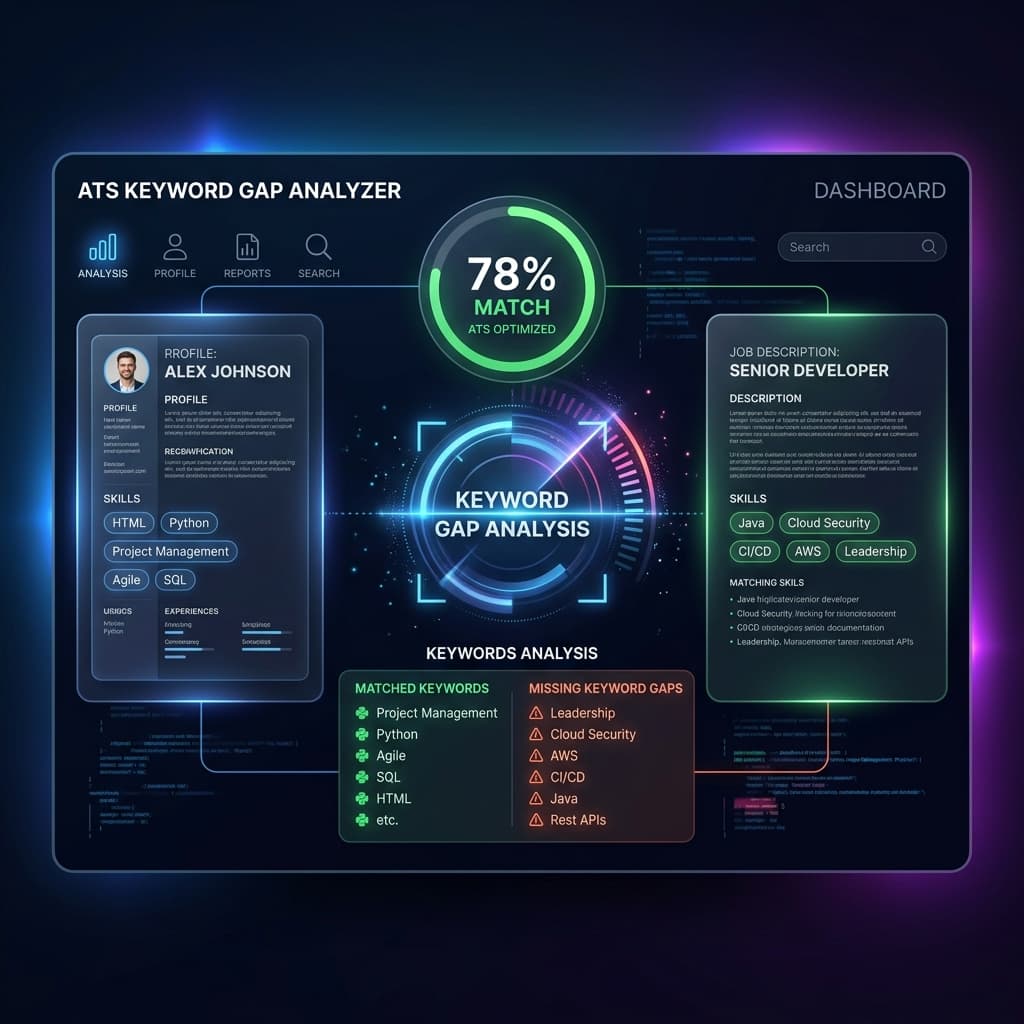
An ats keyword gap analyzer is a specialized software tool that mimics the parsing algorithms used by modern corporate hiring portals. By comparing your resume directly against the job description, it flags the exact skills, tools, and certifications you are missing. In this comprehensive guide, we will explore how this gap analysis works, how to interpret the results, and how to rewrite your resume to pass the ATS screening process every time.
What Exactly is a Resume Keyword Gap?
To understand why you need an ats keyword gap analyzer, you must understand how recruiters search their candidate databases. When a job opening is created, recruiters do not scroll through a chronological list of hundreds of applicants. Instead, they type search queries into their ATS dashboard—very similar to how you use Google.
For example, a recruiter searching for a Project Manager might search for: "Project Management" AND "Agile" AND "Scrum" AND "Jira" AND "PMP". If your resume says you "led cross-functional teams using software development lifecycles" but never explicitly lists the words "Agile," "Jira," or "Scrum," the system will skip your profile entirely.
This disconnect is the keyword gap. You might have years of experience running agile projects, but because you did not use the exact vocabulary the recruiter searched for, the system assumes you do not have the qualification. This is why using an ats keyword gap analyzer is so critical. It acts as an automated auditor, showing you exactly which search terms you left out so you can add them before the recruiter runs their query.
How an ATS Keyword Gap Analyzer Works Under the Hood
Modern ATS software uses natural language processing (NLP) to parse resume files. The software converts your PDF or Word document into plain text and categorizes the information. It then calculates a relevance score by comparing your text against the job description. An ats keyword gap analyzer replicates this process through three key phases:
- Text Extraction: The analyzer strips all formatting, fonts, and layouts to read the raw text of your resume and the job description, just as an ATS parser does.
- Term Frequency Analysis: The tool identifies the most critical keywords in the job description based on how often they appear and where they are located. It filters out common filler words and highlights hard skills, software tools, methodologies, and certifications.
- Gap Comparison: The analyzer cross-references the job description keywords with the text of your resume. Any key term present in the job posting but missing from your resume is flagged as a gap.
By running this comparison, the ats keyword gap analyzer calculates an estimated match score. A score below 60% indicates a high risk of automated rejection, while a score above 80% means your resume is highly optimized and likely to rank near the top of the recruiter's dashboard.
| Keyword Category | Example from Job Post | Why It Matters to the ATS | Analyzer Action |
|---|---|---|---|
| Hard Skills & Tools | Python, SQL, Salesforce, HubSpot | Recruiters use these as binary filters. If you do not have them, you cannot do the job. | Flags as Critical Missing Skill |
| Methodologies | Agile, Scrum, B2B Sales, SEO, SDLC | Determines your familiarity with the company's operating processes. | Suggests Contextual Integration |
| Certifications | PMP, AWS Solutions Architect, CPA | Often set as a strict prerequisite in advanced search filters. | Flags as Prerequisite Gap |
Scan for Keyword Gaps Instantly
Paste your resume and the target job description below to identify missing ATS keywords and optimize your application in real-time.
Upload Resume
PDF, DOCX, or TXT
Tap to upload or drop file
PDF, DOCX, or TXT
Don't have a resume?
Build a professional ATS-friendly resume from scratch in minutes.
Target
Select a Job Role to check your ATS score against that profession and have our AI optimize your resume for it. Switch to Job Description for a precise analysis.
Why Manual Resume Keyword Auditing is Inefficient
Many job seekers try to perform keyword matching manually. They print out the job description, highlight the skills they notice, and try to verify them against their resume. While this is better than doing nothing, manual auditing is incredibly inefficient and prone to human error.
First, human readers often miss minor keyword variations that matter to an ATS. For example, if a job description specifies "ReactJS" and your resume lists "React.js," a basic keyword parser might miss the match entirely. A high-quality ats keyword gap analyzer is programmed to recognize synonyms, abbreviations, and variation patterns, ensuring your formatting matches the parser's logic.
Second, manual auditing is incredibly time-consuming. Auditing a single resume against a job description can take up to an hour. If you are applying to multiple positions a week, manual customization becomes a full-time job in itself, leading to job search fatigue. By using an automated ats keyword gap analyzer, you can scan your document and receive a complete list of missing keywords in less than 30 seconds.
Step-by-Step: How to Use an ATS Keyword Gap Analyzer to Optimize Your Resume
Once you have run your resume through an ats keyword gap analyzer, you will receive a report listing the matching keywords and the missing keyword gaps. Here is how to systematically address the gaps and optimize your document:
1. Optimize Your Professional Summary First
The summary at the top of your resume is the first thing human recruiters read, and it is prime real estate for high-priority keywords. Review the most critical missing keywords flagged by the ats keyword gap analyzer and weave them into this section. For instance, if you are a marketer and the analyzer flags "digital campaign optimization" as a missing keyword, update your summary to highlight your expertise in optimizing digital campaigns.
2. Weave Keywords Naturally Into Your Work Experience
Do not just create a list of keywords and dump them at the bottom of your resume. Modern, AI-powered ATS systems evaluate the context in which keywords are used. Use the recommendations of the ats keyword gap analyzer to rewrite your accomplishment bullets. Instead of saying you "analyzed sales data," rewrite it to say you "utilized Salesforce CRM to analyze sales trends and optimize the sales pipeline." This demonstrates both your technical skill and the business value you delivered.
3. Standardize and Categorize Your Skills Section
Your skills section should act as a clean index of your technical capabilities. Group your skills into logical subheadings (e.g., Programming Languages, Software Packages, Methodologies). Ensure that the spelling of every tool and skill matches the exact terms flagged by the ats keyword gap analyzer. This makes it incredibly easy for both the ATS parser and the human recruiter to verify your technical qualifications.
Common Keyword Optimization Pitfalls to Avoid
While closing the keyword gap is essential, it is easy to go too far and hurt your chances. When using an ats keyword gap analyzer, make sure to avoid these common optimization pitfalls:
- Keyword Stuffing: Do not copy and paste lists of keywords repeatedly or force them into sentences where they do not make sense. Modern ATS systems use natural language processing to detect keyword stuffing and will automatically lower the rank of spammy-looking resumes. Furthermore, if a human recruiter reads a resume that looks like a robot wrote it, they will reject it immediately.
- Hidden Text: Never use the outdated "white font hack" to hide lists of keywords in your resume's margins. When the ATS parses your document, it strips all color formatting and converts the text to plain black. The hidden keywords will show up as a suspicious block of text at the end of your parsed profile, leading to immediate disqualification.
- Fabricating Experience: The purpose of an ats keyword gap analyzer is to help you translate your genuine experience into the terminology the employer uses, not to invent qualifications you do not have. If the analyzer flags a keyword you have no experience with, do not add it. It is better to have an 85% match score with truthful information than a 100% score that you cannot defend in an interview.
Leveraging ATS Resume Flow for Career Success
If you want to ensure your resume is fully compliant and optimized, you need a specialized platform built for modern recruitment trends. ATS Resume Flow provides a complete suite of tools designed to build, check, and optimize your resume for automated parsing engines.
Our platform integrates a real-time ats keyword gap analyzer with an interactive AI-powered resume builder. This system automatically formats your resume according to industry standards, keeping margins, fonts, and columns safe for parsing. It analyzes your resume against target job postings in real-time, highlighting exact keyword gaps and suggesting precise bullet point rewrites to help you bridge those gaps.
Stop losing job opportunities to automated filters. Upload your current resume to our ats keyword gap analyzer today, identify the critical gaps in your application, and submit your next application with the confidence that your qualifications will be seen by human eyes.